


Heat transfer plays a crucial role in petrochemical reaction towers, influencing both the efficiency and effectiveness of chemical processes. As a leading supplier of Petrochemical Reaction Tower, I am well - versed in the various heat transfer processes that occur within these towers. In this blog, we will delve into the key heat transfer mechanisms, their significance, and how they impact the overall performance of petrochemical reaction towers.
1. Conduction in Petrochemical Reaction Towers
Conduction is the transfer of heat through a solid material without the movement of the material itself. In a petrochemical reaction tower, conduction occurs in several components. The tower walls, made of metals such as steel, are good conductors of heat. Heat is transferred from the hot reaction mixture inside the tower to the outer surface of the tower wall through conduction.
The rate of heat conduction is governed by Fourier's law, which states that the heat flux (q) is proportional to the temperature gradient (dT/dx) and the thermal conductivity (k) of the material. Mathematically, it is expressed as (q=-k\frac{dT}{dx}). In the context of a petrochemical reaction tower, the thermal conductivity of the tower wall material is a critical factor. High - quality steel with good thermal conductivity ensures efficient heat transfer from the inside of the tower to the surroundings.
For example, in a distillation tower, the heat from the reboiler is conducted through the tower wall to the outside. This heat loss can be minimized by using insulation materials on the outer surface of the tower. Insulation reduces the temperature gradient across the wall, thus decreasing the rate of heat conduction and improving energy efficiency.
2. Convection in Petrochemical Reaction Towers
Convection is the transfer of heat by the movement of a fluid (liquid or gas). In petrochemical reaction towers, there are two types of convection: natural convection and forced convection.
Natural Convection
Natural convection occurs due to density differences in the fluid caused by temperature variations. In a petrochemical reaction tower, when the reaction mixture is heated, it becomes less dense and rises, while the cooler fluid near the top of the tower sinks. This creates a natural circulation pattern within the tower.
For instance, in a Distillation Column, the reboiler heats the bottom liquid, causing it to vaporize. The hot vapor rises through the column, and as it cools, it condenses on the trays or packing materials. The condensed liquid then flows back down to the bottom of the column. This natural convection process is essential for the separation of different components in the distillation process.
Forced Convection
Forced convection involves the use of external means, such as pumps or fans, to move the fluid. In petrochemical reaction towers, forced convection is often used to enhance heat transfer. For example, in a cooling system, a pump circulates coolant through a heat exchanger attached to the tower. The coolant absorbs heat from the reaction mixture and transfers it to the environment.
The heat transfer coefficient (h) is an important parameter in forced convection. It depends on factors such as the fluid velocity, the properties of the fluid, and the geometry of the heat transfer surface. By increasing the fluid velocity, the heat transfer coefficient can be increased, leading to more efficient heat transfer.
3. Radiation in Petrochemical Reaction Towers
Radiation is the transfer of heat through electromagnetic waves. In petrochemical reaction towers, radiation plays a role, especially at high temperatures. The hot reaction mixture and the tower walls emit thermal radiation.
The rate of radiation heat transfer is given by the Stefan - Boltzmann law, (q=\epsilon\sigma T^{4}), where (\epsilon) is the emissivity of the surface, (\sigma) is the Stefan - Boltzmann constant ((5.67\times10^{-8}W/m^{2}K^{4})), and T is the absolute temperature of the surface.
In a high - temperature petrochemical reaction tower, the radiation heat transfer can be significant. For example, in a cracking tower where the temperature can reach several hundred degrees Celsius, the radiation from the hot reaction mixture to the tower walls and vice versa can have a notable impact on the overall heat balance. To reduce radiation heat loss, reflective coatings can be applied to the tower walls. These coatings have a low emissivity, which reduces the amount of radiation emitted from the surface.
4. Heat Transfer and Tower Performance
The heat transfer processes in a petrochemical reaction tower have a direct impact on its performance. Efficient heat transfer is essential for maintaining the desired reaction temperature, ensuring proper separation of components, and optimizing energy consumption.
Temperature Control
Proper heat transfer is crucial for controlling the temperature inside the tower. In a reaction tower, different reactions occur at specific temperatures. If the heat transfer is not efficient, the temperature may deviate from the optimal range, leading to reduced reaction rates or the formation of unwanted by - products.
For example, in a polymerization reaction tower, the reaction rate is highly dependent on temperature. If the heat is not transferred effectively, the temperature may fluctuate, resulting in inconsistent polymer quality.
Separation Efficiency
In distillation towers, heat transfer is directly related to the separation efficiency. The vapor - liquid equilibrium in the tower is influenced by the temperature profile, which is determined by the heat transfer processes. A well - designed heat transfer system ensures that the temperature gradient is maintained across the tower, allowing for efficient separation of different components based on their boiling points.
Energy Efficiency
Efficient heat transfer can significantly reduce energy consumption in petrochemical reaction towers. By minimizing heat losses through conduction, convection, and radiation, less energy is required to maintain the desired temperature. For example, using insulation materials and optimizing the heat exchanger design can improve the overall energy efficiency of the tower.
5. Our Role as a Petrochemical Reaction Tower Supplier
As a supplier of Petrochemical Reaction Tower, we understand the importance of heat transfer in the performance of these towers. We design and manufacture towers with advanced heat transfer features to ensure optimal performance.
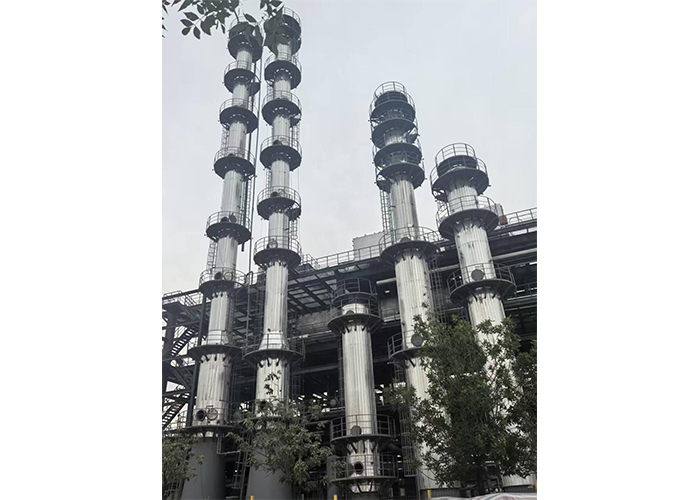

Our towers are constructed using high - quality materials with excellent thermal conductivity to facilitate efficient conduction. We also incorporate insulation materials to minimize heat losses. In addition, our towers are equipped with advanced cooling and heating systems that utilize forced convection to enhance heat transfer.
We offer a range of Distillation Column and Distillation Tower options, each designed to meet the specific heat transfer requirements of different petrochemical processes. Our engineering team works closely with clients to understand their needs and design customized solutions that optimize heat transfer and overall tower performance.
If you are in the market for a petrochemical reaction tower or have any questions about heat transfer in these towers, we invite you to contact us for a detailed discussion. Our experts are ready to assist you in selecting the right tower for your specific application and ensuring that it operates at peak efficiency.
References
- Incropera, F. P., & DeWitt, D. P. (2002). Fundamentals of Heat and Mass Transfer. John Wiley & Sons.
- Perry, R. H., & Green, D. W. (1997). Perry's Chemical Engineers' Handbook. McGraw - Hill.
- Sinnott, R. K. (2005). Chemical Engineering Design: Principles, Practice and Economics of Plant and Process Design. Butterworth - Heinemann.


