
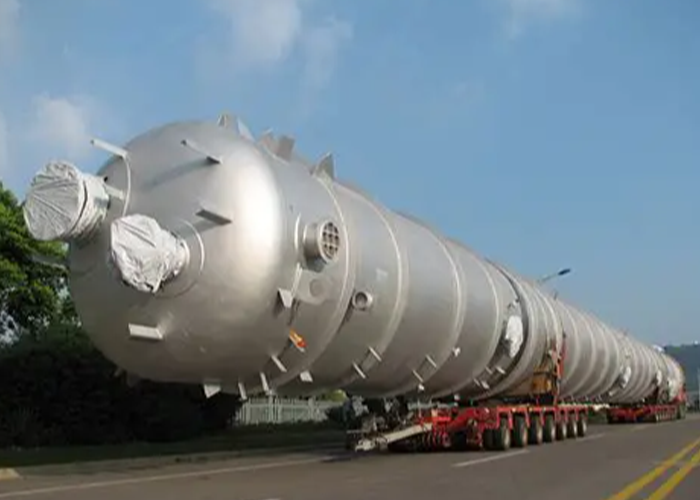
The core challenge of vacuum distillation lies in the necessity of performing the separation at the lowest possible temperature; otherwise, coking, cracking, and column blockage are highly likely. Therefore, what truly determines the success or failure of the system is not the size, but rather the ability to control pressure drop within the column, mass transfer efficiency, flow stability within the column, and the heat load distribution structure.
All our vacuum distillation columns are designed starting from the "lowest allowable operating temperature," and the internal column structure is calculated accordingly, rather than simply scaling up the parameters of conventional distillation columns.
product Advantages
Ultra-low Pressure Drop Structure
By optimizing the flow channel cross-section of the tower internals and the specific surface area and gas velocity range of the structured packing, the total pressure drop of the single-tower system is typically controlled at 2–4 kPa, which is 20–35% lower than traditional structures. This significantly reduces the separation temperature and lowers the probability of coking.
High-Efficiency Mass Transfer, Increased Yield of Heavy Distillates
The use of large specific surface area structured packing and a dedicated liquid redistribution structure significantly increases the gas-liquid contact area. Actual test data shows that under the same operating conditions, the yield of heavy distillates can be increased by 3–7%, and by-products are reduced.


Uniform Heat Load Distribution, Preventing Local Overheating
The internal flow guiding structure has been optimized through thermal flow simulation, controlling the wall temperature difference within a reasonable range, reducing the formation of hot spots, and preventing coking and local cracking on the tower wall.
Structure Adapted for Long-Term Continuous Operation
The materials for key heated areas can be selected from high-temperature and sulfur-corrosion-resistant materials such as Cr-Mo and duplex stainless steel, allowing the equipment to operate continuously and stably for more than 12–24 months under high-sulfur crude oil conditions.

Industry Applications
Vacuum distillation unit (vacuum section)
01
Separation of heavy oil and residue oil
02
Deep processing of high-sulfur crude oil
03
Improving the recovery rate of VGO and vacuum gas oil
04
Reducing the load on the coking unit
05
Customization and Engineering Design Capabilities
First Round:
● Deriving Structural Parameters from Separation Targets
● Based on the crude oil TBP curve, cutting point temperature, and target yield,
● recalculate the required theoretical stages and effective mass transfer height.
● Determine the tower diameter and internal component selection range.
Second Round:
● Specialized Calculation of Pressure Drop and Coking Risk
● Perform sectional simulation of the total tower pressure drop.
● Optimize the porosity and gas velocity range of the structured packing.
● Ensure the total pressure drop is controlled within the 2–4 kPa range, directly reducing the probability of coking.
Third Round:
● Heat Load and Wall Hot Spot Control
● Establish a heat load distribution model for the tower body.
● Optimize the flow guide structure and wall thickness structure.
● Prevent local overheating and wall coking.
Customizable content includes tower diameter, tower height, tower section module division, structured packing specifications, material and layer height, redistributor, demister structure, sulfur-resistant and high-temperature resistant materials (Cr-Mo / duplex stainless steel / nickel-based alloys), flange standards, interface orientation, and foundation load matching.
EPC interface drawings, lifting and assembly plans are provided simultaneously.
Packaging, Shipping and Delivery Guarantees
Modular Segmented Delivery System
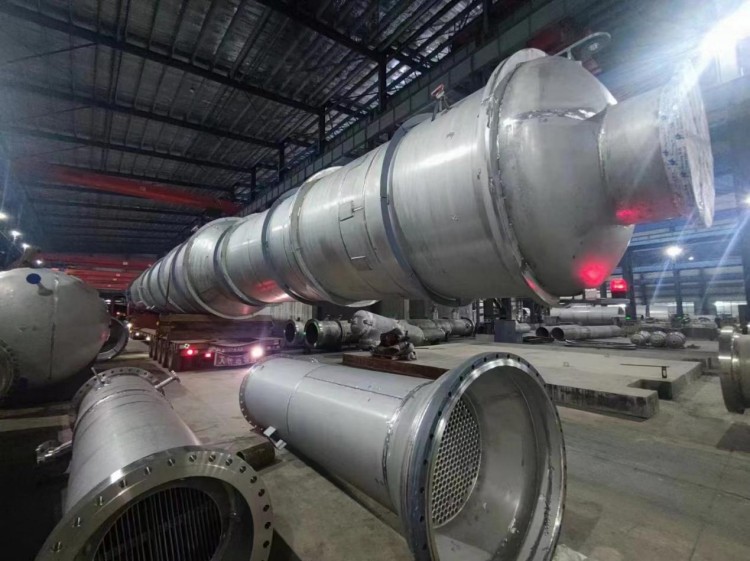
● Modular segmentation based on tower height and transportation conditions
● Each segment undergoes independent pre-assembly of internal components
● Reduces on-site high-altitude installation time and rework risks
● Significantly shortens on-site lifting and installation cycle
Export-Grade Multi-Layer Protective Packaging
● Steel structure reinforced frame
● Independent protection for critical flange sealing surfaces
● Moisture-proof desiccant placed inside
● Full-process shockproof fixation
● Prevents transportation deformation and corrosion
On-Site Assembly and Commissioning Support
● Provides complete assembly sequence diagrams and lifting point diagrams
● Provides interface dimension verification tables
● Provides suggested startup parameters
● Remote or on-site commissioning guidance available
● Project milestone-based progress coordination

Send us your crude oil properties, target cut points, existing pressure drop, and production specifications, and we will reverse-engineer a truly low-temperature, low-coking, and high-yield vacuum distillation tower for you.
Hot Tags: vacuum distillation tower, China vacuum distillation tower manufacturers, suppliers, factory, Atmospheric Distillation Column, Packed Tower, Distillation Tower, Vacuum Distillation Tower, Distillation Column, chemical tower


